Inside Dune’s On-Chain Data Platform and AI Strategy
Dune is turning public blockchain data into usable insights with multi-chain infrastructure, AI-first tools, and a new stablecoin dataset built with Visa and Steakhouse.

Genzio
Inside Dune’s On-Chain Data Platform and AI Strategy
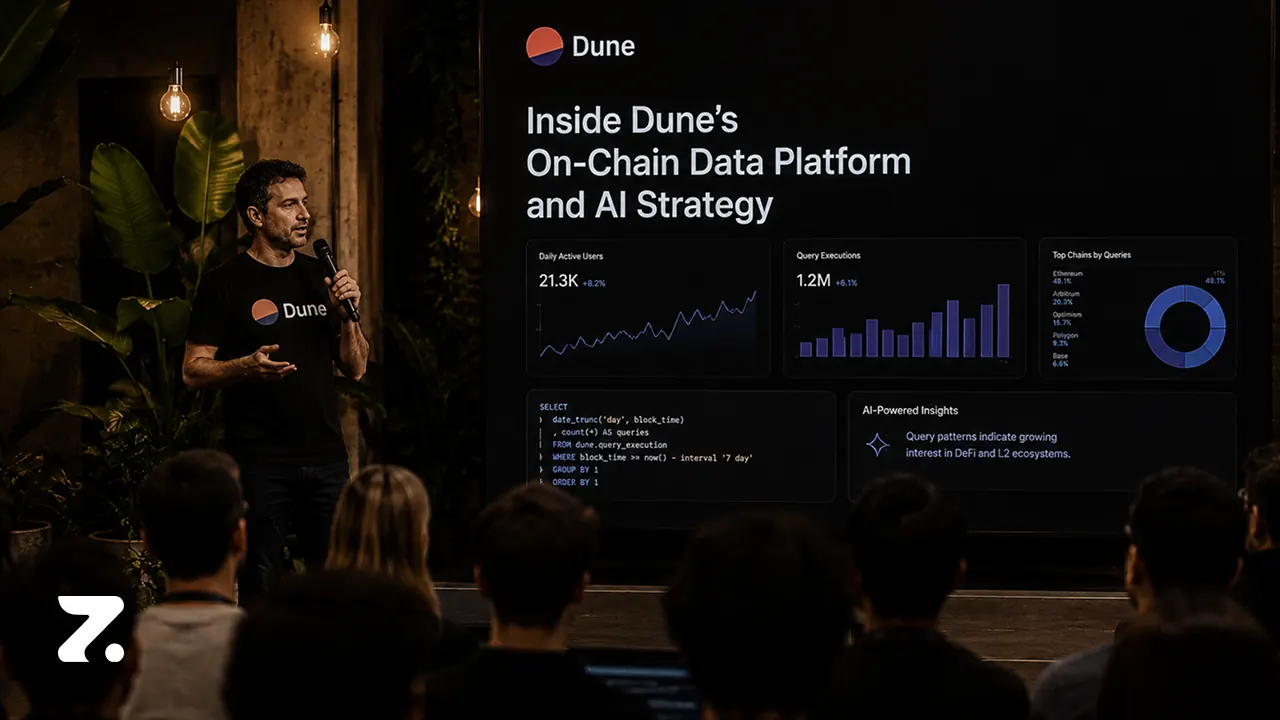
At ETHDenver, Dune VP of GTM Arnaud Simeray highlighted a simple idea with big implications: blockchain data may be public, but it is still hard to use. Dune’s mission is to make that data accessible, readable, and usable for analysts, businesses, and AI systems.
From multi-chain indexing to AI agent integrations and an upcoming stablecoin dataset, Dune is positioning itself as more than a dashboard tool. It is becoming core infrastructure for on-chain analytics.
Dune’s ETHDenver takeaway: smaller event, better conversations
Dune’s team came away impressed by the quality of conversations at ETHDenver. While the event felt more focused and less crowded than larger conferences, that worked in its favor. The booth stayed busy, and attendees were serious about building, investing, and adopting blockchain data tools.
This mirrors a larger trend in crypto events: the most valuable gatherings are often the ones where the noise drops and the real use cases rise to the surface.
For more event coverage and industry context, see our latest events coverage.
What Dune is and why it matters
Dune is an on-chain data platform that helps users query, analyze, and visualize blockchain data. It supports more than 130 blockchains, including both EVM and non-EVM networks, and provides curated datasets across major crypto categories.
That means users can work with data from Ethereum, Polygon, Solana, Tron, and many other ecosystems without building their own indexing stack from scratch.
Learn more about platform-led growth in our finance coverage and broader digital infrastructure stories in our main category hub.
The real problem Dune solves: making public blockchain data usable
Blockchain data is public, but public does not mean easy. Raw on-chain data is fragmented across networks, highly technical, and difficult to query directly. Dune solves that by turning raw chain activity into something people can actually read and use.
The platform removes a major barrier for businesses and analysts: they do not have to build and maintain their own infrastructure to make sense of blockchain activity.
Data is indexed from genesis
Information is cleaned and standardized
Tables are made human-readable
Users can query across many chains in one place
How Dune’s data infrastructure works behind the scenes
According to Simeray, Dune has spent years and significant capital building the infrastructure behind the product. That includes storing historical chain data, transforming it, and making it fast enough for modern use cases.
This behind-the-scenes engine is what enables Dune to serve both human users and AI systems that need fast, reliable access to large datasets.
If you are interested in similar technology trends, explore our AI news coverage.
Curated datasets that go beyond raw blockchain data
Dune is not just a place to inspect transactions. It also offers opinionated datasets for specific use cases like stablecoins, DEXs, protocols, and prediction markets. That makes it easier to analyze what is happening in a particular corner of crypto without starting from zero.
This approach matters because most teams do not want raw data alone. They want fast answers, reusable tables, and clear business context.
Dune’s AI strategy: internal first, product second
AI is now part of Dune’s internal workflow across product, engineering, finance, talent, and go-to-market teams. The company says it defaults to AI-first thinking whenever possible, using automation before starting new manual projects.
That internal mindset is also shaping the product roadmap. Dune wants users to be able to interact with blockchain data more naturally, including through prompts, charts, and AI agents.
Introducing Dune MCP
One of the biggest updates is Dune MCP, which is designed to connect Dune’s data directly to external AI agents. In practice, that means users will be able to ask complex questions in natural language and tap into Dune’s large data surface without manually stitching together dozens of sources.
Dune’s official MCP announcement shows how the company is pushing toward a world where blockchain analytics can be queried as easily as any other AI-enabled data source.
Natural-language querying for on-chain data
Faster access for AI agent workflows
Chart generation from prompts
More flexible analysis across chains and datasets
The upcoming stablecoin dataset
Dune is also preparing a major stablecoin release in partnership with Visa and Steakhouse. The upcoming dataset will cover more than 200 stablecoins and will include non-USD stablecoins as well.
That matters because stablecoins are no longer just a U.S.-centric story. Adoption is growing across Latin America, Africa, and Asia, where regional issuers and payment use cases are expanding quickly.
For the latest product announcements, Dune’s official blog updates are the best place to follow along. You can also explore the institutional relevance of stablecoins through Visa’s payments ecosystem and Steakhouse Financial’s research-driven perspective.
Dune’s expanding user base
Dune started as a community favorite for dashboard builders, but its user base has expanded significantly. Today, the platform serves crypto-native companies, enterprises, institutions, and public-sector users.
Exchanges and market infrastructure providers
Protocols and DeFi teams
VC firms and research teams
Banks and asset managers
Government entities and accounting firms
This shift shows that on-chain analytics is moving from niche use case to serious business infrastructure.
How to access Dune
Dune remains easy to explore. Users can sign up for free, browse public dashboards, and work with the platform’s core data products directly through Dune’s homepage. The company also maintains a strong presence on social channels, which helps keep developers and analysts informed about new releases.
As on-chain adoption grows, tools like Dune are becoming essential for anyone who needs fast, trustworthy blockchain insight.
FAQ
What does Dune do?
Dune is an on-chain data platform that indexes blockchain data and makes it easier to query, analyze, and visualize across many networks.
Why is blockchain data hard to use?
Although it is public, blockchain data is fragmented, technical, and difficult to query directly without specialized infrastructure.
What is Dune MCP?
Dune MCP is a product layer that connects Dune’s blockchain data to external AI agents so users can query data more naturally.
Who uses Dune today?
Dune is used by crypto-native teams, institutions, banks, VCs, government entities, and companies that need reliable on-chain analytics.
About

Featured Posts




Explore Topics