Gradient at ETHDenver: Decentralized AI for Builders
Gradient is building decentralized AI infrastructure for local inference, cheaper post-training, and user-owned compute. Here’s how Parallax, Echo, and Common Stack fit into Web3’s AI future.

Genzio
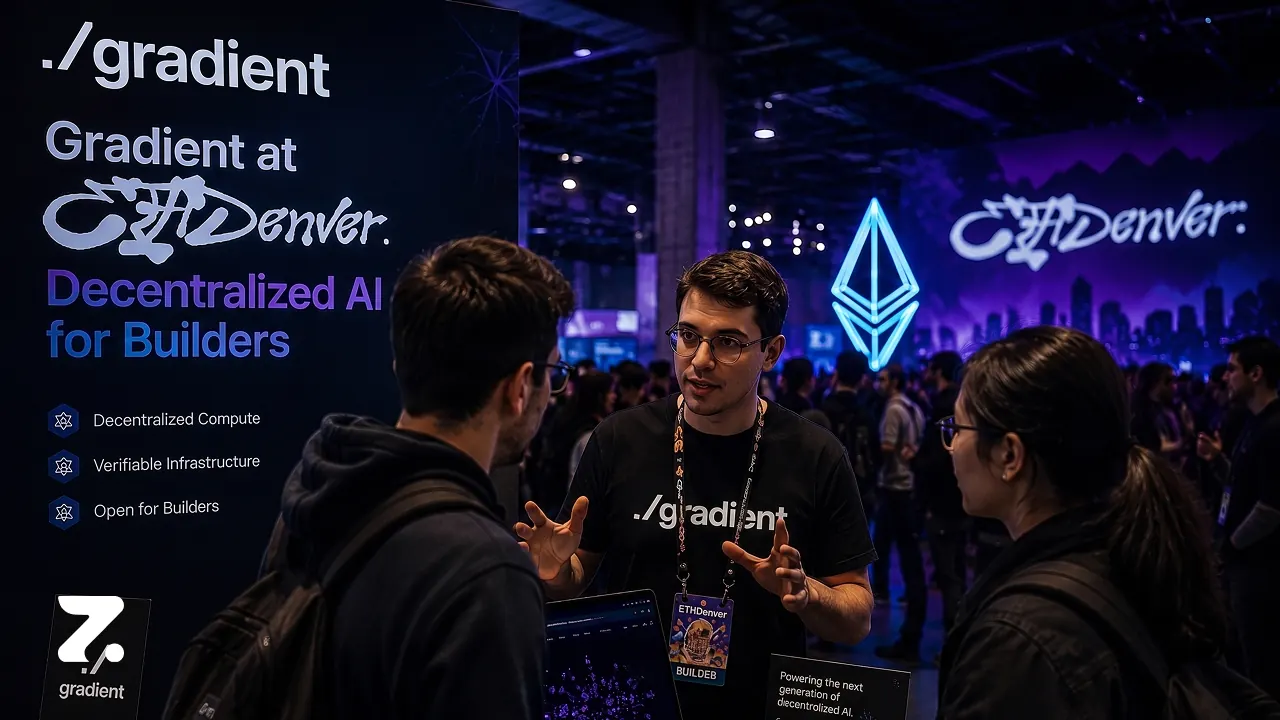
Gradient at ETHDenver: Decentralized AI for Builders
At ETHDenver, Gradient’s message was clear: the future of AI infrastructure may be local, distributed, and far more accessible than traditional cloud-only stacks. In a market that is still sorting itself out, Gradient is focused on one thing—helping companies run and train AI models on hardware they control.
That pitch fits especially well in a builder-heavy environment like ETHDenver. The event draws people who care about practical tools, not just speculation. And in that context, Gradient’s mix of AI infrastructure, cost reduction, and Web3-aligned ownership feels timely.
For readers looking for more coverage on emerging tech and industry shifts, GenZioMedia regularly tracks the biggest stories across AI news and infrastructure, major industry events, and broader culture trends shaping technology.
What Gradient Is Building
Gradient is building AI infrastructure that helps companies run inference and post-training on local or distributed GPU resources instead of relying entirely on centralized cloud systems.
More data control: companies can keep proprietary data closer to their own environment.
Lower infrastructure costs: distributed compute helps reduce expensive cloud dependency.
Greater flexibility: teams can adapt compute setups to their own latency, privacy, and scale needs.
The company’s approach is especially relevant for startups and automation platforms that need custom model behavior without the budget of a large AI lab. For a broader look at how AI business models are evolving, see our finance coverage on the economics behind new technologies.
Parallax, Echo, and Common Stack
Gradient’s product stack is designed to cover multiple layers of AI deployment and training.
Parallax supports local inference, letting users run models on their own computers or distributed hardware.
Echo handles distributed post-training and reinforcement learning workflows.
Common Stack aggregates cloud access and helps users access hosted models efficiently.
Together, these products create a hybrid infrastructure model: local when privacy and control matter, distributed when training needs scale, and cloud when users want fast access to top models. You can learn more about the company’s positioning on the official Gradient platform overview.
Why the Cost Story Matters
One of Gradient’s biggest selling points is cost reduction. The company says its post-training approach can cut costs by about 80% in some workflows, which is a major deal for teams building AI products on tight budgets.
That matters because post-training and reinforcement learning can become expensive quickly. By using consumer hardware and existing GPUs, Gradient tries to make advanced AI workflows available to far more companies than traditional setups allow.
It is also a strategic fit for the current AI market, where many companies want better model performance but cannot justify massive infrastructure spend. This is where open model ecosystems and efficient serving tools also come into play, including platforms like Hugging Face for open model development and deployment.
Why Web3 and AI Overlap Here
Gradient’s overlap with Web3 is more than branding. The idea of user-owned infrastructure maps closely to crypto-native values like ownership, distributed participation, and incentive-driven compute networks.
The company has also signaled plans for a Gradient token that could help coordinate GPU supply and incentivize a resource pool. In practice, that looks similar to a subnet-style network where companies can build a more personalized compute layer rather than relying on one giant shared cloud.
That model has clear parallels in the decentralized infrastructure ecosystem, including Akash Network’s decentralized cloud marketplace and Bittensor’s token-incentivized AI network.
Who Uses Gradient Today
Gradient is primarily a B2B platform. While individual developers can use it for local model workflows, its strongest fit appears to be with companies building AI products and automation tools.
AI agent platforms
Sales automation tools
Marketing automation systems
Customer support workflows
Teams training on proprietary company data
These users care about access, flexibility, and cost. They want to run models efficiently and, increasingly, to customize them on data that they own. That is exactly the problem Gradient is trying to solve.
What ETHDenver Revealed About the Market
One of the strongest themes from ETHDenver was that the serious builders are still building. Even in a bear market, the conference atmosphere was optimistic, practical, and focused on shipping useful products.
That matters because AI and crypto both reward teams that stay active through cycles. The companies that learn how to build in down markets often become the ones that benefit most when sentiment turns.
Gradient’s presence at the event also showed how AI and Web3 are converging around real infrastructure. The conversation is less about hype and more about practical questions like: How do you lower costs? How do you preserve ownership? How do you make compute more accessible?
For readers following more builder-focused coverage, GenZioMedia’s events section and homepage are good places to stay updated on emerging industry moments.
What’s Next for Gradient
The roadmap includes a few important milestones, especially Echo V2. The company has also discussed open-sourcing more of its post-training stack so developers can run it on their own machines.
That could make the platform more attractive to builders who want more transparency, more control, and lower barriers to experimentation. It also strengthens Gradient’s position in the decentralized AI conversation, where useful tooling matters more than ideology alone.
In a market where AI adoption is becoming unavoidable, Gradient’s pitch is simple: give companies access to powerful tools without forcing them into costly, centralized systems.
FAQ
What is Gradient?
Gradient is an AI infrastructure company focused on local inference, distributed post-training, and cloud aggregation for companies that want more control over their models and data.
How does Gradient reduce AI costs?
Gradient uses distributed and consumer-grade hardware to lower the cost of post-training and reinforcement learning, which can make advanced AI workflows significantly cheaper.
What are Parallax, Echo, and Common Stack?
Parallax handles local inference, Echo supports distributed post-training, and Common Stack provides cloud access to hosted models and model availability.
Why is Gradient relevant to Web3?
Gradient aligns with Web3 values like user-owned infrastructure, distributed participation, and incentive-based resource networks, especially through its planned t
About
Featured Posts


Explore Topics