Why Google’s $40B Bet on Anthropic Changes the AI Compute Game
Google's up-to-$40B cash and compute partnership with Anthropic is a decisive move that accelerates the AI arms race, reshapes model availability, and centralizes training power in a few hands.

Genzio
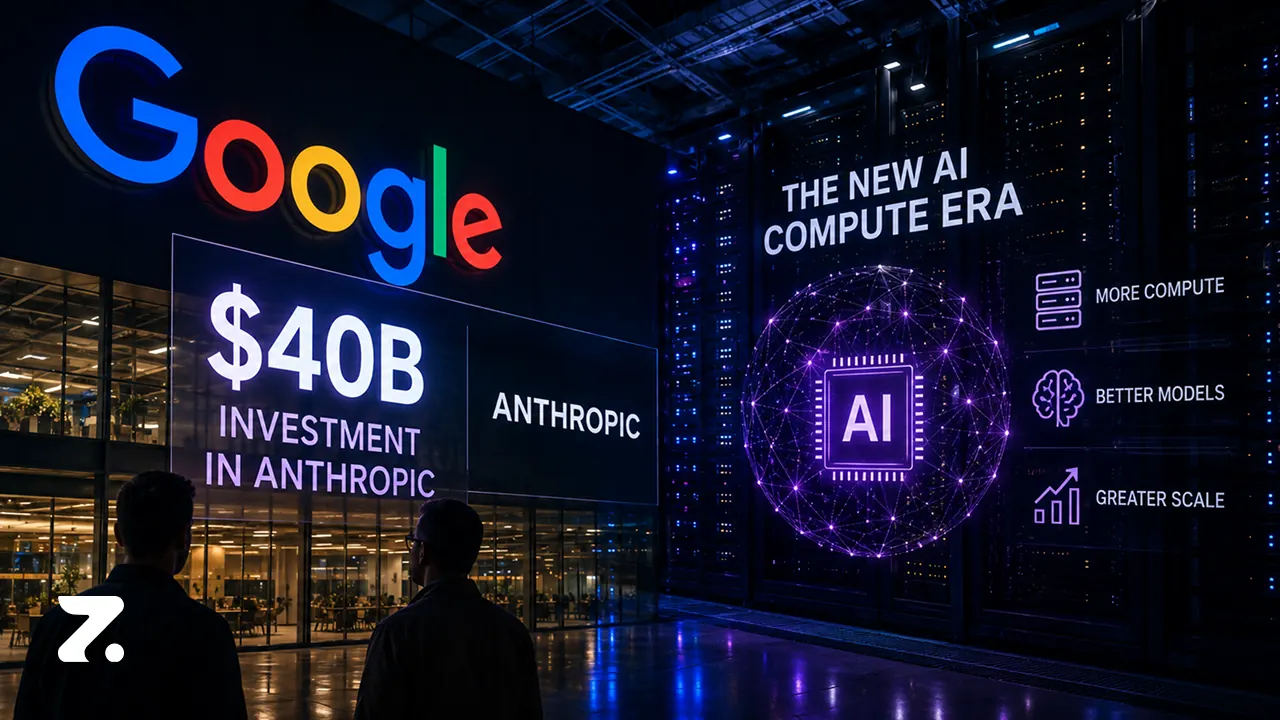
Is Google’s massive deal with Anthropic a winner-takes-most moment?
The headline is blunt: up to $40 billion in cash and compute. But the real story is less about the number and more about what that number buys — guaranteed access to enormous, specialized GPU fleets and preferential engineering attention. I believe this deal will speed the arms race and make powerful models less widely available in the short term. For ongoing coverage of similar developments see Genzio Media's AI News.
Strategic compute, not just a financial infusion
Cash matters, but in large-scale model development the gating factor is often sustained, high-performance compute and the right integrations with cloud services. Google isn’t just sending money; it’s committing fractional ownership and prioritized access to its datacenter GPU capacity. That changes planning horizons. A startup with predictable, prioritized compute can iterate models faster, run larger experiments, and lock in performance leads in ways that pure funding alone can’t deliver. Agencies monitoring vendor ecosystems should read guidance on platform dependencies at Genzio Media's category hub.
Real-world example: Mythos and a limited rollout
Anthropic’s Mythos model was released selectively with cybersecurity-focused use cases before a broader rollout. That limited availability showed two things: one, Anthropic can tune models for niche, high-value applications; two, limited releases create scarcity and urgency among enterprise customers. With Google’s compute commitment, future Mythos iterations can be trained and deployed faster, but they may remain gated to select partners at first, mirroring Mythos’s phased approach.
Comparison: This isn’t Microsoft-OpenAI redux, but it’s similar
Microsoft’s partnership with OpenAI focused on Azure consumption and embedding models into Microsoft products. Google’s arrangement emphasizes both cloud integration and deep technical alignment with Anthropic’s research stack. The comparison highlights a pattern: hyperscalers secure tight relationships with leading model developers to control infrastructure demand and capture downstream value. The endgame looks similar — platform lock-in and prioritized product integration — even if the mechanics differ. For broader media and cultural implications see Genzio Media's culture coverage.
What this likely means for model availability
My strong opinion: expect more gated launches, enterprise-first rollouts, and licensing terms that favor large customers. When a handful of cloud providers control the largest pools of compute, they effectively shape which models get trained, how quickly, and who uses them. That centralization can speed innovation but will likely limit broad, public access to the very top-tier models for at least a few quarters or years.
Concrete numbers and the economics of scale
The headline figure — $40,000,000,000 — is useful as a signal. On the operational side, think in measurable terms: maintaining prioritized access to tens of thousands of GPUs across multiple regions reduces queuing, lowers experiment latency, and cuts iteration times from weeks to days for large-scale runs. Those time savings compound: shave off 50–70% of training turnaround and you can cycle models and guardrails far more quickly.
Downstream impacts: customers, competitors, and researchers
For customers, the deal promises faster product integrations and perhaps lower per-inference costs for services built on Anthropic models hosted on Google’s infrastructure. For competitors, it raises the bar: rival cloud providers will feel pressure to secure similar bets or offer alternative advantages like better pricing, regulatory compliance assurances, or niche accelerators. For independent researchers and smaller startups, the picture is mixed — more powerful tools may be developed, but access to them could be mediated through commercial relationships rather than open research releases.
Risks and trade-offs
Concentrating compute and capital brings efficiency but also systemic risk. If a few pairings of cloud provider and model developer dominate, outages or policy shifts at those providers have outsized effects. Regulatory scrutiny could intensify, especially where national security or data residency intersect with advanced model capabilities. The trade-off is speed and scale versus diversity and resilience.
Where Genzio fits in
Agencies and media strategists like Genzio will need to rethink how they evaluate vendor claims and partner ecosystems. Messaging around model capabilities will increasingly be tied to underlying infrastructure guarantees — not just model architecture. That creates both opportunities (clearer performance guarantees) and challenges (vendor lock-in). Visit Genzio's homepage for agency resources and strategy notes.
Small list of immediate tactical takeaways
Enterprises should assess not only model features but also cloud-provider dependencies.
Startups must weigh the benefits of privileged partnerships against long-term portability.
Researchers should document reproducibility constraints tied to specialized hardware access.
News context and reporting links
For a detailed timeline of the announcement and follow-up reporting, see Google's coverage of the initial story in the news feed: detailed announcement.
Shortly after, analysts compared the deal dynamics to other hyperscaler arrangements in coverage available here: analyst roundup.
Operational and technical reporting on infrastructure commitments is summarized in a separate report here: infrastructure report.
Regulatory and competitive responses were tracked in a follow-up piece here: regulatory tracking.
FAQ
Q: Does the $40B mean Anthropic is now owned by Google?
A: No. The deal gives Google strategic investment and compute commitments, not full ownership. It does, however, tie Anthropic’s roadmap closely to Google’s infrastructure.
Q: Will this make advanced models less available to the public?
A: Likely in the near term. Prioritized compute and selective rollouts tend to favor enterprise partners, which can delay broad public access.
Q: How does this affect competition among cloud providers?
A: It raises competitive stakes. Other providers will either pursue similar deep partnerships or differentiate with pricing, compliance, or unique accelerators.
Q: Should companies change procurement strategies now?
A: Yes. Evaluate infrastructure commitments and negotiate portability clauses, since compute alignment will increasingly determine model performance and availability.
About
Featured Posts

Explore Topics